
Something's crooked about our home planet
/
The sun sets on the bay of Fundy in August 2024. - john mcphee
When we lived in the Annapolis Valley, I often dreaded the drive home from the Herald newsroom in Halifax this time of year.
People who regularly use Highway 101 know what I’m talking about. The open fields on both sides of the highway are perfect for creating whiteouts.
But winter driving has its challenges even on a clear day.
The low-lying Sun is a constant irritation on an east-west highway like the 101. Driving west, it’s either directly in your eyes or slightly to the left, so you have to keep moving your visor around. Driving east, it's ideally positioned for optimum blinding potential between the rearview mirror and the passenger side visor.
Darn you orbital motion and planetary axial tilt!

Tilted worlds
Most planets don’t spin completely upright in space. Their rotations were knocked askew in the early years of the solar system billions of years ago when planets, asteroids and other celestial bodies regularly whacked into one another.
The only exception is Mercury, the closest planet to the Sun. Mercury’s rotation is almost perfectly upright, only two degrees off the perpendicular, likely due to its proximity to the Sun’s huge tidal effect.
At the other extreme are planets such as Uranus, which has an axial tilt of about 98 degrees, creating an almost sideways rotation.
If Earth wasn’t tilted, there would be about 12 hours of sunlight everywhere all year long. Here in Nova Scotia, the temperature would hover around 7 C, give or take a couple of degrees. So yay, no short winter days or icy sidewalks! But boo, no forests! The lack of seasonal temperature spikes would create a tundra environment in the 40 to 50 latitude zones, British meteorologist Robin Smith postulates.
But odds are there wouldn’t be any people around to bemoan the lack of trees anyway. The climate on a non-tilted Earth would have limited human development to scattered settlements, according to Don Attwood, an ecological anthropologist at McGill University.
While Earth’s tilt of 23.4 degrees is comparatively minor, it’s enough to create seasonal changes throughout the year. Beginning in the fall, Earth's northern hemisphere begins to turn away from the Sun. As a result, the Sun gradually appears lower in the sky and terrestrial temperatures take a hit from the more indirect sunlight.
When the Sun’s path hits bottom, sometime between Dec. 20 and Dec. 23, we've reached the winter solstice. Ironically this occurs at the point in Earth's orbit when we're closest to the Sun (known as the perihelion).
Latin for “standing still of the Sun,” solstice refers to the point where the Sun reaches its most northerly (summer) or southerly (winter) point relative to the celestial equator. As a result, in summer the Sun rises in the northeast in Nova Scotia and in the southeast in winter.
In 2024, the winter solstice will occur Dec. 21 at 09:20 Universal Time (5:20 a.m. Atlantic). Since the Sun is at its lowest angle, this will be the shortest day of the year at only eight hours, 48 minutes and 35 seconds, according to timeanddate.com.
Compare that to the summer solstice when the Sun is in the sky between 15 and 16 hours. And - yippee - it’s also way higher in the sky and out of our eyes on those long drives west.
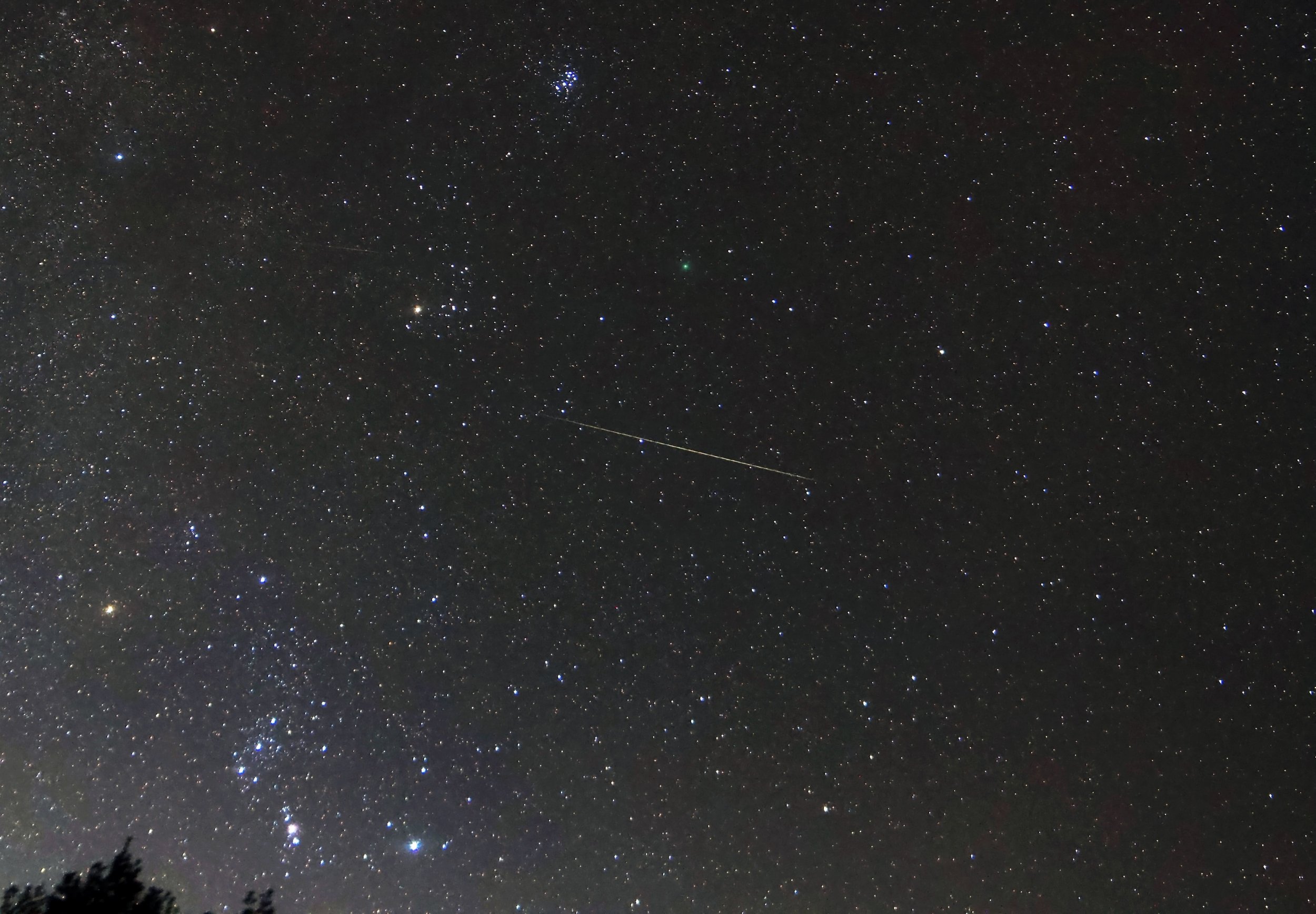
A meteor streaks through the orion/taurus region in may 2023. The green dot above the meteor is the comet 46p/Wirtanen.- john mcphee
Solstice stars
The winter solstice has been marked by festivals and other celebrations since ancient times across the world. As usual, the Caribbean folks have the coolest sounding name for their event. During Junkanoo, people dress up in flamboyant costumes and hit the streets.
After your solstice party, be sure to check out the gems of the winter sky that decorate the southeast at this frigid time of year. This region is packed with stellar show-offs — the red, blue and yellow giants that make up the winter constellations of Auriga, Taurus and Orion.
There’s no constellation like Orion for bright stars and sheer presence.The Hunter dominates the eastern horizon in December and January. You’ll likely first notice its “belt” of three stars (from left Alnitak, Alnilam and Mintaka) or the bright blue supergiant Rigel to the lower right.
Above the Hunter is its quarry, Taurus the Bull. Its most luminous star, Aldebaran, is the only member of this constellation that really stands out. This red giant shines about 360 times brighter than the Sun.
That’s dim compared to the luminosity of other giant and supergiant stars, but Aldebaran is relatively close at 67 light-years.
Aldebaran appears to be a part of an arrow-shaped cluster called the Hyades. But that’s an optical illusion caused by our perspective on Earth. The rest of the Hyades group lies on the same line of sight as Aldebaran but they’re about twice as far away.