A dogged journey into the cosmos

Don't get me wrong. I like dogs, I really do. But I also enjoy, you know, not seeing one every two minutes.

Look, there's a dog sitting in the passenger seat of a car parked outside a restaurant in north-end Halifax, watching us eat.

 Hey, there's one of those bizarre miniature mutts in a shopping cart, where the kid usually is.

And another dog is pushing the cart!

OK, maybe it hasn't gotten to that point. But sometimes it does seem that canine domesticus is taking over the world.

The relationship between dogs and humans goes back a long way, of course.

The ancients thought so much of their furry friends that they immortalized them in the firmament.

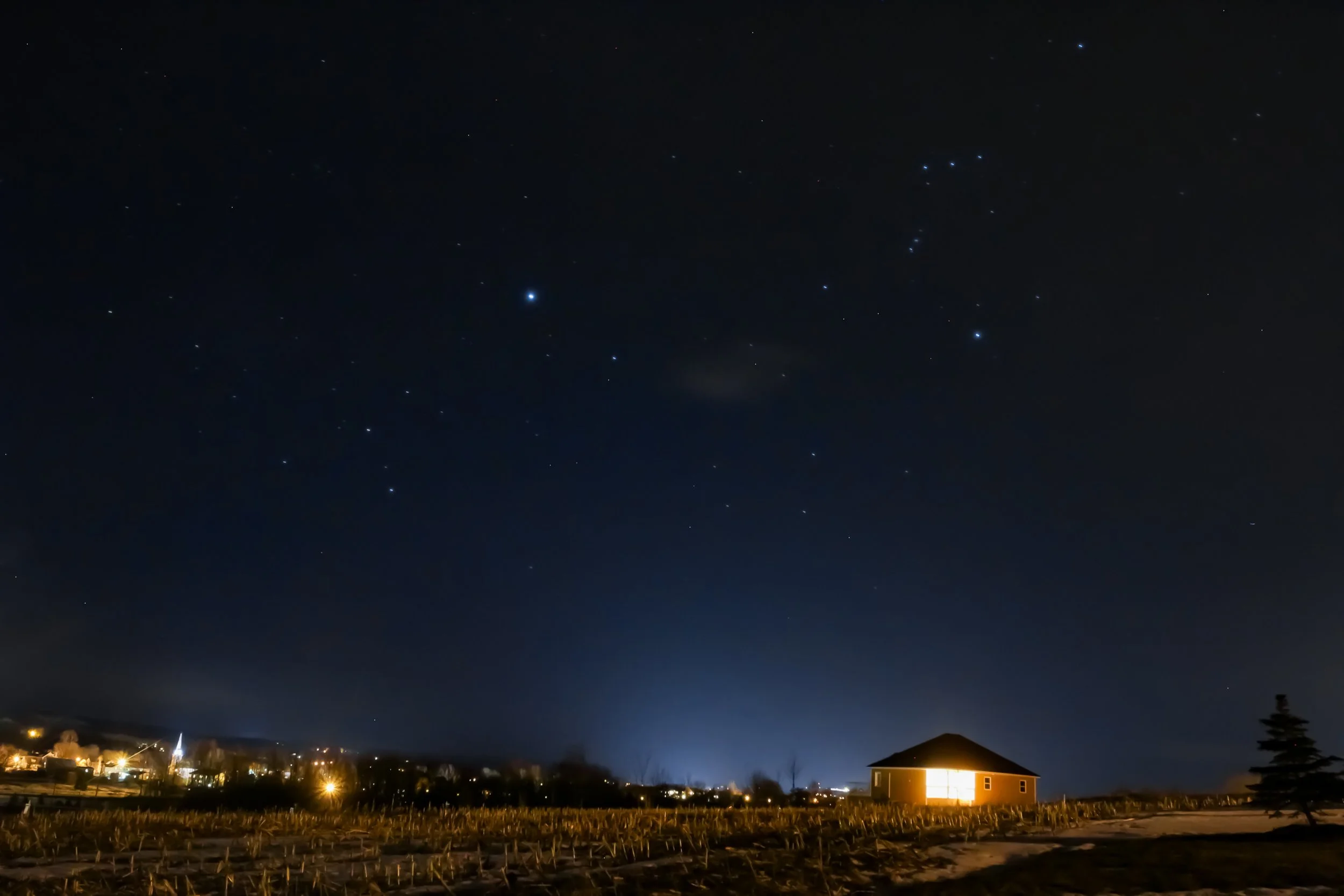
The brightest star in the sky, Sirius, blazes low in the west in march 2015 in the annapolis valley of nova scotia. sirius is the alpha star of the constellation canis major, the great dog. part of the constellation orion can be seen to the right. - John mcphee

The brightest star in the sky, Sirius, can be seen blazing very low in the early evening in May. It is found in the constellation Canis Major, the Big Dog. Above this constellation, you can test your constellation-location skills by finding the tiny constellation Canis Minor - you guessed it, the Little Dog.

Then there's the lesser known celestial yappers. I came upon one of them by chance one evening a few years ago in the constellation Virgo. I noticed a star just to the west of Saturn (which had moved into Virgo at the time), bright enough to stand out but not one I recognized.

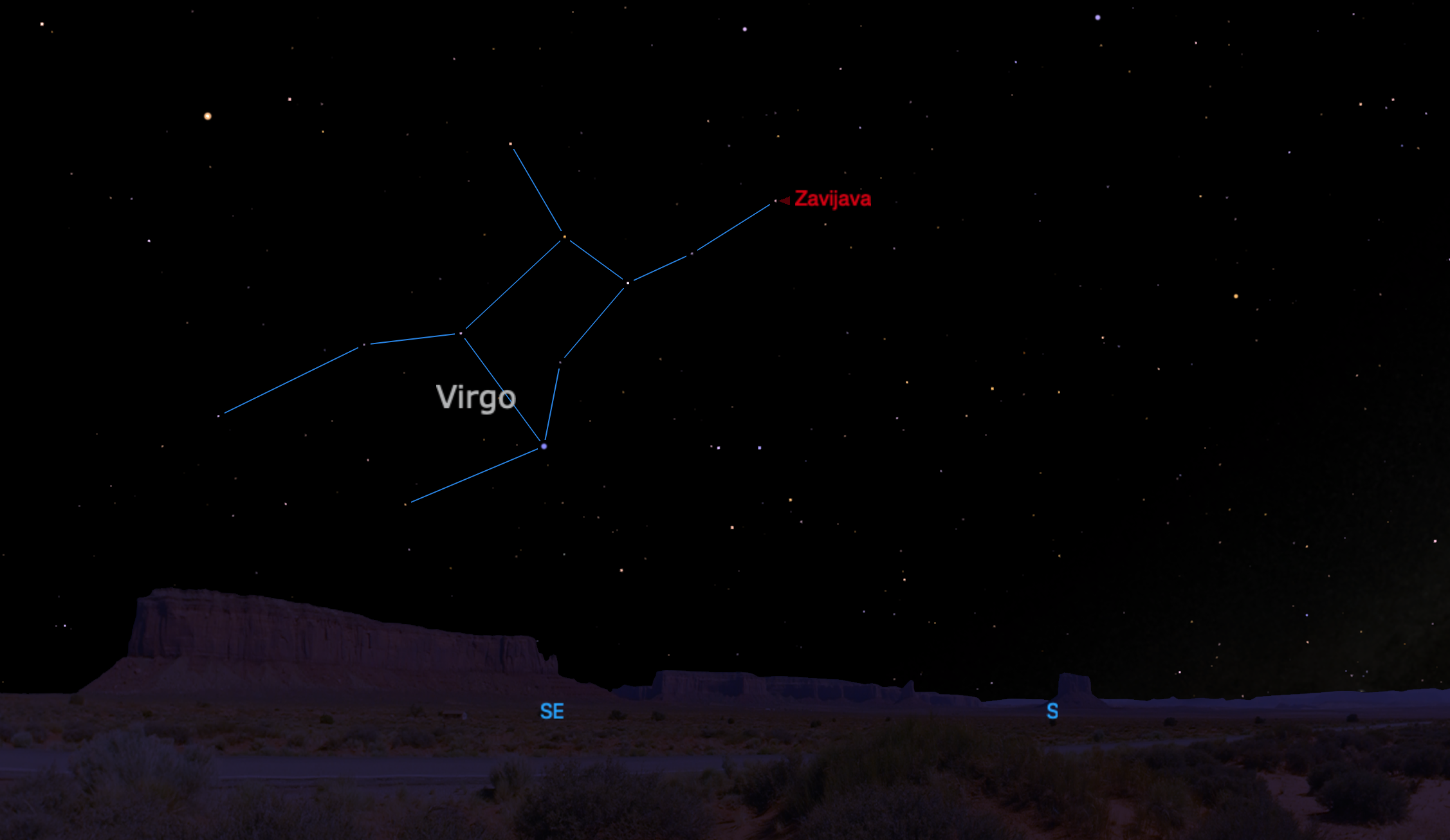
It turns out this star has a pretty cool name, Zavijava (zah-vee-JAH-va). That’s Arabic for "the angle," according to astronomer Jim Kaler's website.

The name refers to Zavijava's position in a string of stars known to the ancient Arabs as "awwa," which some translate as the kennel or the barking dog.

Zavijava's position in a string of stars in virgo was known to the ancient Arabs as "awwa," which some translate as the kennel or the barking dog. the graphic above shows its position in nova scotia at about 8 a.m. - starry night / curriculum

Einstein's star

Zavijava lies about 36 light years away - fairly close for a star. On the other hand, Saturn, the sixth planet from the Sun, is a mere billion or so kilometres away.

In some ways, Zavijava is a typical breed of star - it's not that much larger or intrinsically brighter than our Sun. But it has an interesting history. Einstein used it during the solar eclipse of Sept. 21, 1922, to determine the speed of light in space. The scientist was able to use Zavijava as a celestial measuring stick because its path takes it close to the ecliptic, the path followed by the Sun and planets in the sky.

For the same reason, it often appears near planets and is even occulted, or covered, by them. Mark down Nov. 9, 2210, on your calendar when Venus will occult Zavijava, according to Wikipedia. There’ll be a similar occultation a little sooner (2069) but you’ll have to go to the South Pole to see it.

Wiki also tells us it's believed this star is orbited by at least one Jupiter-sized planet. Even the regular mutts of the cosmos can have an interesting tale to tell.

A walk with Grandmother Moon

The full moon rises above Herring Cove in August. (JOHN McPHEE)

The full moon rises above Herring Cove in August. (JOHN McPHEE)

Note: This article was first published in September 2016 so the references to planets and the Moon don’t apply to the current night sky. Also after years of work, Dave and Cathy have published Mi’kmaw Moons: The Seasons in Mi’kma’ki. Illustrated by Loretta Gould, it’s availalbe through Formac Lorimer Publishing.

On this first evening of September, come outside with me and celebrate the coming autumnal equinox with a tour of the night sky.

The weather forecast isn’t hopeful so we may have to use our imaginations.

Overhead  — we’ll also have to imagine there’s no light pollution — the path of gas and dust that marks the heart of our galaxy, the Milky Way, splits the sky.

To the west, let’s enjoy a final glimpse of Mars and Saturn as they close out their summer show in the constellation Scorpius.

Now where’s the Moon? Nowhere to be found. It’s the time of new Moon, also known as no Moon. Our closest neighbour in space is hidden in the glare of the sun.

From new to first-quarter (to the eye, that’s a half-moon) to full to last-quarter and back to new: This cycle of phases is created by the changing angle of sunlight on the lunar surface as our satellite traces an elliptical loop around the Earth.

Moonrise over dartmouth on nov. 14, 2016 - john mcphee

That’s the science behind the lunar cycle. But the changing face of the Moon, particularly the timing of the 12 or 13 full phases during the year, carries a much deeper meaning in many cultures.

Ancient peoples such as the Mi’kmaq incorporated the lunar and other celestial cycles into their mythology as well as their daily lives. The Mi'kmaw calendar was based on crucial periods such as the hunt and the harvest.   

RELATED: Step out with the Moon

The Mi’kmaw yearly ecological cycle is represented by natural events such as the running of the maple sap (Si’ko’ku’s), the croaking of frogs (Sqoljuiku’s) and moose calling their mates (Wikumkewiku’s). The common 12 Mi'kmaw Moon times and full Moons take their names from these events. Occasionally a 13th Moon time is needed to keep the moontimes in step with the sun.

“Our people lived off the land so knowing what was coming up, what resource, was very important to their survival,” Cathy Jean LeBlanc, an expert in Mi’kmaw culture, told me in a recent interview from her home in Newcombville, Lunenburg County.

Ancient peoples such as the Mi’kmaq incorporated the lunar and other celestial cycles into their mythology as well as their daily lives. - john mcphee

“Knowing that the animals were about to get nice and fat and we were going into fall and that would be a time when we would hunt.”

LeBlanc and Dartmouth amateur astronomer Dave Chapman are the creators of the education website Mi’kmaw Moons, which celebrates the time-keeping and scientific interpretation traditions of the Mi'kmaq.

For LeBlanc, it’s all about the connection between daily life and the natural world, which for her is synonymous with the spiritual world.

“We believe every single thing in nature has spirit,” said LeBlanc, who is a physical activity co-ordinator for Acadia First Nation and previously worked at Kejimkujik National Park and Historic Site as a cultural interpreter.

“And so for us, everything is living and that’s why we respect everything around us. ... The rocks, the water, the trees, everything to us is a living being with a spirit.”

Not surprisingly, it’s sometimes a challenge for her to reconcile that spiritual view with the scientific approach of somebody like Dave Chapman. But it’s been a positive learning experience for both of them.

“We were working together ...  and we came across this concept of Two-Eyed Seeing,” Chapman recounted in an interview earlier this summer, an idea that was developed at Cape Breton University by Albert Marshall and Cheryl Bartlett.

 “It’s where you kind of look at everything from a traditional indigenous perspective but also from a western scientific perspective.

“You can express it different ways, it means different things to different people. A blend, a yin-yang, two ways of seeing and knowing, and one respects the other.”

The Mi’kmaw yearly ecological cycle is represented by natural events such as the running of the maple sap (Si’ko’ku’s), the croaking of frogs (Sqoljuiku’s) and moose calling their mates (Wikumkewiku’s). The common 12 Mi'kmaw moon times and full moon…

The Mi’kmaw yearly ecological cycle is represented by natural events such as the running of the maple sap (Si’ko’ku’s), the croaking of frogs (Sqoljuiku’s) and moose calling their mates (Wikumkewiku’s). The common 12 Mi'kmaw moon times and full moons take their names from these events. Occasionally a 13th moon time is needed to keep the moontimes in step with the sun. (MI'KMAW MOONS)

The Mi’kmaw Moons project grew out of a 2014 presentation the pair gave to the Royal Astronomical Society of Canada's Halifax centre called In Search of the 13th Mi'kmaw Moon.

“I’ve always been interested in the cultural side of astronomy,” said Chapman, a retired federal scientist who volunteers much of his time promoting astronomy at Kejimkujik and beyond.  

“For many decades, I’ve read books about archeoastronomy, the astronomy of ancient peoples, different civilizations,” which led him to explore how modern aboriginal cultures in our region see and interpret the sky.

LeBlanc said she gets particular satisfaction from sharing her knowledge with young people, such as the children she works with at Acadia First Nation, and with family members. 

“I always use my niece Holly for an example. She’s eight years old and she’s been learning about the Mi’kmaw Moon times and she’s been celebrating and living those for the last two years. And that’s what’s important to me — it’s fine if you can give people 12 or 13 Mi’kmaq Moon names and people can learn them and memorize them. But it’s that deep connection — once you have that connection to them (seasons), you don’t forget it.”

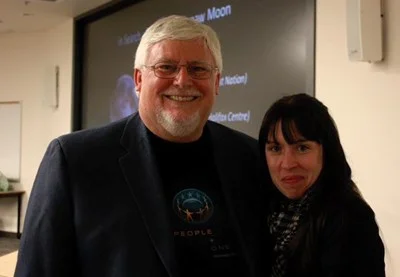
Mi'kmaw Moons collaborators Dave Chapman and Cathy Jean LeBlanc. (FACEBOOK)

Mi'kmaw Moons collaborators Dave Chapman and Cathy Jean LeBlanc. (FACEBOOK)

LeBlanc laughs as she recounts the first time that connection hit home for her. It was during a February day drive along the South Shore while holding a Bluetooth conversation with Chapman about the project. The glare off the snow was distracting her so “I said, 'Dave, I can’t see anything, I have to pull off and put my sunglasses on.'

“He said, ‘You know what time we’re in?’ And I said, 'Oh my God, I’m experiencing it, we’re in Snow-blinding Time!' ”

The Mi'kmaw Moons project has turned out to be a great success. LeBlanc and Chapman have held many presentations for groups such as the Confederacy of Mainland Mi’kmaq, schools and the Minas Astronomy Group.

The work has gained international recognition as well. The pair submitted a paper on the project for the respected Griffith Observer Magazine, which is produced by the Griffith Observatory in Los Angeles. The essay won second prize and will be published in the Observer in November, Chapman said. 

crescent moon and jupiter at kejimkujik on aug. 5, 2016. - john mcphee

LeBlanc admits she didn’t spend a lot of time looking at the sky before she became involved in the project.

“I’ve learned to look up and appreciate all the things above me,” she said.

And it's reinforced those important connections with her culture, ancestry and the natural world. 

“The Moon in our culture is our grandmother — so we have Mother Earth and Grandmother Moon. ... My ancestors would have been looking up and lying on the ground perhaps around the fires and wigwams and telling stories. I’d like to think there was this anticipation, this excitement about what was to come."

No File

Cast your eye to the southern sky

The sagittarius region boasts a rich collection of nebulae and star clusters. - john mcphee

IT'S LUCKY FOR modern stargazers that comet hunter Charles Messier was an organized gentilehomme.

When the 18th century French astronomer came across something that later could be mistaken for a comet, down it went into his notebook. His list of things to ignore evolved into a valuable record of the sky's most impressive sights, from M1 to M110.

The southern horizon in summer boasts a treasure trove of these objects, particularly in the constellations Scorpius and Sagittarius. This area is packed with star clusters and clouds of glowing gas and dust called nebulae.

This month marks prime-time viewing for Scorpius although it crawls pretty low along the horizon in the northern hemisphere. Scorpius is named for the venomous desert arachnid that, in Roman mythology, killed Orion, the glittering hunter whose constellation haunts the winter skies far away from his mortal enemy.
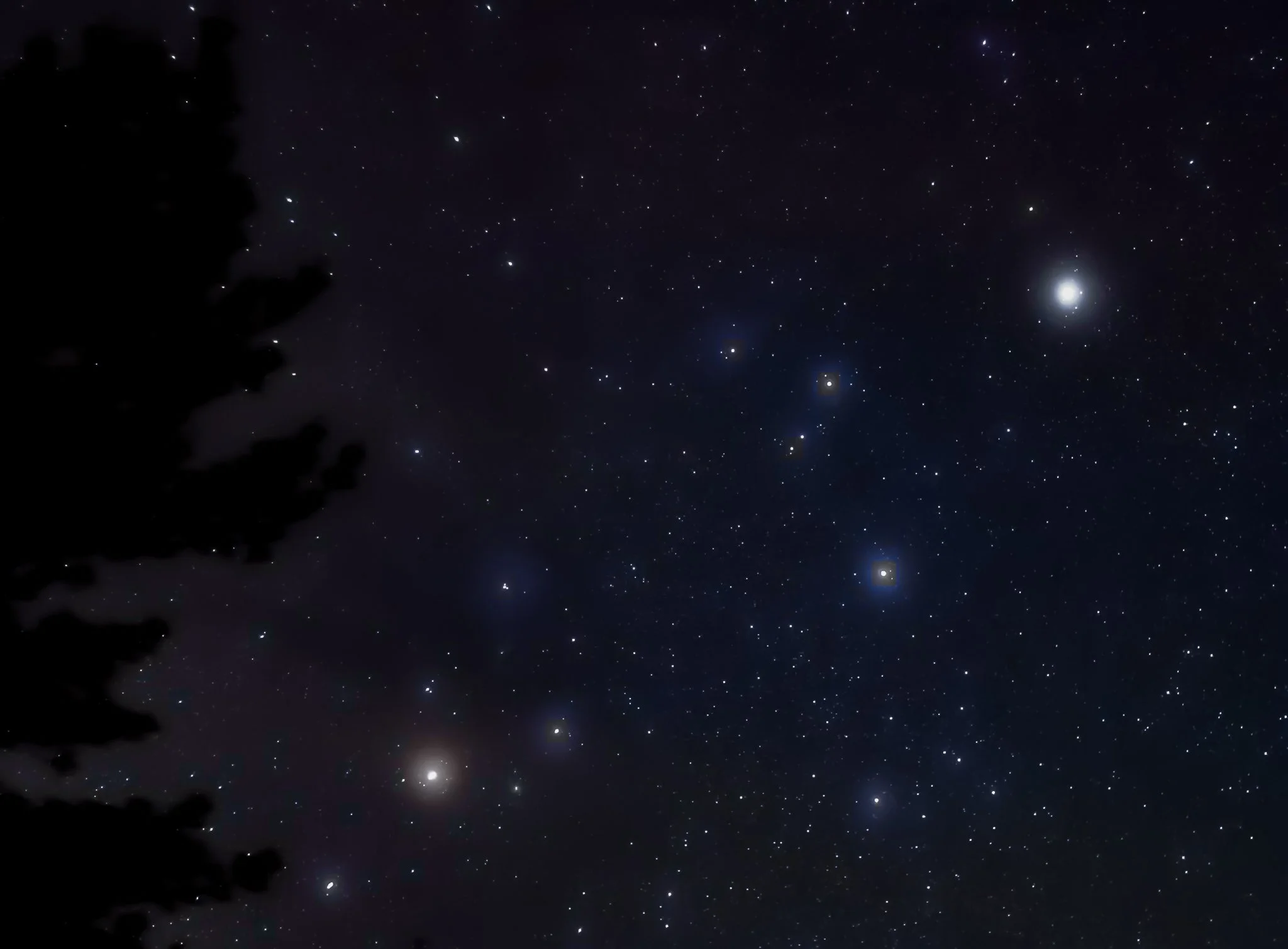
high cloud added a dreamy look to this photo of saturn (top right) and the constellation scorpius on june 21, 2015. the bright star near bottom left is antares. - john mcphee

Unlike a lot of constellations, Scorpius doesn't require much of an imaginative leap to see the creature behind its' name. The scorpion hangs just above the southern horizon - a fishhook or the letter J also comes to mind.

At the heart of Scorpius beats Antares, the star whose red hue inspired the Romans to name it the "rival of Mars." About 500 of our suns could fit into Antares, a red giant star about 500 light-years away.

But time is running out for this huge ball of gas. Its density is less than one-millionth that of our Sun and when it finally runs out of fuel, “Antares will collapse and explode in a supernova - at which time its brightness will rival that of the rest of our galaxy put together,” according to NASA scientists.

If you train a pair of binoculars on Antares, you may notice a hazy patch in the same field of view to the right. That's M4, a group of stars called a globular cluster. (See photo below) M4 may look like Antares' neighbour but this incredibly dense group containing hundreds of thousands of stars lies 7,500 light-years from Earth.
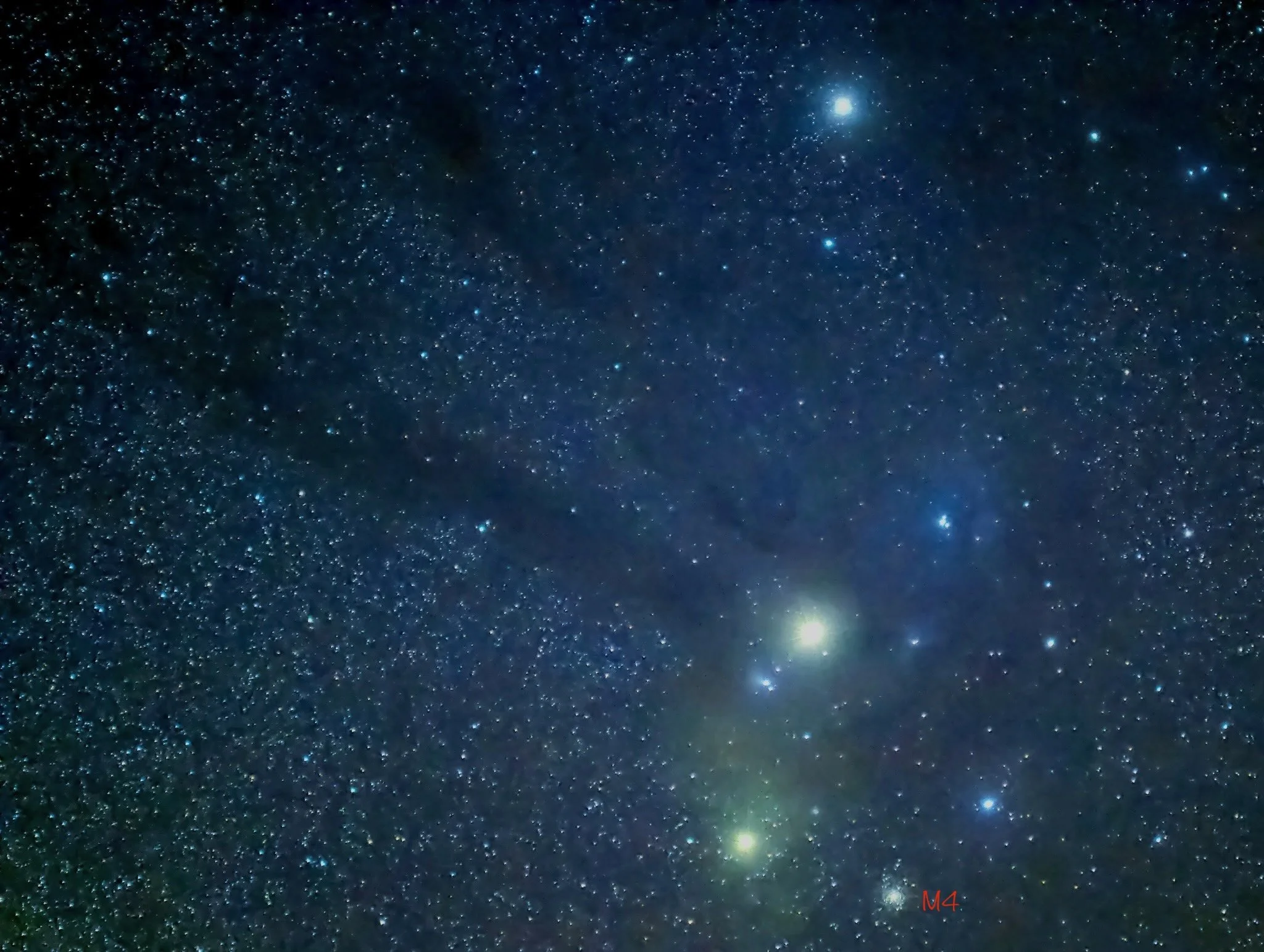
Saturn (at top centre), Mars and the star Antares line up in the constellation Scorpius on Aug. 24, 2016. the star cluster m4 is shown to the right of antares. - john mcphee

As with all globulars, it takes a larger telescope to make out individual stars in M4. In my 90-millimetre scope, the foggy patch takes on a sort of pebbly appearance, particularly on a night of good "seeing" - that is, when the atmosphere is steady and there's little haze in the air.

A more satisfying sight in binoculars and small scopes are looser collections of stars called open clusters. Scorpius boasts a couple of beauties, M7 and M6. They lie just above the tail of the scorpion. On a moonless night of great seeing, M7 shines like a scattering of jewels in my 10x50 binoculars. I can also make out the nebula in M6.

You can often get a better view of fainter objects like nebulae if you don't look right at them. Avert your eyes slightly to the side and a more distinct image pops into view. This technique takes advantage of more light-sensitive areas on the sides of the retina.

Whatever part of the eye you use, it’s the best time of year to soak up the celestial riches at the heart of our home galaxy.
When the night sky makes the news

The pre-dawn sky on June 3 will include a thin crescent moon (centre) and several visible plants - adapted from starry night

IT’S A DOUBLE-EDGED sword when unusual astronomical events get big coverage in the mainstream and social media. 

In recent years, the term “supermoon” has been used to describe full moons that are slightly larger than the norm because the Moon is closest to Earth in its orbit. 

These “perigees” coincide with the full Moon several times a year. 

As with most things astronomical, close is a relative term. At perigee the Moon is still about 356,000 kilometres from Earth, compared to about 407,000 at its farthest point known as apogee. 

And it’s a reach to call the Moon supersized when it’s closest to Earth given that it’s only about seven per cent larger. But the term supermoon appears to have caught the popular imagination when it comes to our lunar companion and I’m all for anything that turns more eyes toward the sky. 

I’ll add a caveat to that when it comes to blatantly misleading rumours or social media trends. The big offender in recent years has been misinformation about the size of Mars when it makes a relatively close approach to Earth. Mark your calendars! Mars will be as big as the full Moon!

The full moon is a lovely sight whether it’s “super” or not. - john mcphee

Not so much. The Red Planet does get much brighter during its closer approaches and it’s a beautiful sight. But like all the planets, it’ll simply look like a particularly bright star. 

The planets have been in the news lately under the headline “planetary parade.” Several will be visible in the pre-dawn sky in June 2024, accompanied by a crescent Moon from June 1 to June 5. 

The “stars” of the show will be Jupiter and Mercury, which will appear to be very close together very low on the northeastern horizon. It will be easy to tell them apart because Jupiter is much brighter than Mercury.

Unfortunately the pair will be very low in the sky and will quickly disappear as the Sun approaches the horizon.

An extremely thin crescent Moon will be above Jupiter and Mercury on June 5, with the bonus of the star cluster Pleiades just above the Moon.

Mars and Saturn also will be visible to early risers above the east and southeast horizon respectively. But Mars is relatively far away from Earth these nights so it will be much dimmer than Saturn. 

Neptune and Uranus also will be part of the planetary show in June but you’ll need large binoculars - preferably mounted on a tripod - or a telescope to see them.

I’ve been pounding the mallet a bit on this and don’t intend to dissaude anyone from following up on astronomical news. By all means get up early to spot our companions in the solar system but do so with tempered expectations.

See also Skylights for June 2024

The enduring fascination of Mars

The planet mars (lower left) as seen from nova scotia on march 28, 2013. - john mcphee

(ARCHIVED FROM AUGUST 2003)

There's Orion and the Pleiades and I guess that must be Mars. - Greg Brown, Poet's Game

UNLESS HE WAS IN THE DEEP SOUTH, Mr. Brown was contemplating the heavens in winter when he wrote that tune.

Orion is nowhere to be seen on these sultry nights up north - but there's no guesswork about Mars.

The brilliant golden orb can't be missed low in the east late in the evening early in August and earlier as the month goes on.

I figured the planet would be striking, since Mars is nearing its closest approach to Earth in about 60,000 years. And it stands out even more because it's the lone planet in our evening skies and occupies a rather sparse bit of sky in the Capricorn/Aquarius region.

And indeed, it’s a fascinating sight.

With some planets, such as Venus, it's easy to mistake them for just really bright stars. Look at Mars and you just sense something's different about it. The reason behind that difference may be a tad mundane, in that its deep golden colour is created by good old rust - iron oxide - in the Martian soil.

The appreciation of our planetary neighbour with the naked eye, that's one thing. Put your typical backyard scope to work - that would be mine - and the excitement pales a bit. I'm not seeing much detail on that fourth rock from the sun.

from top, Saturn, Mars and the star Antares line up in the constellation scorpius on Aug. 24, 2016. - john mcphee

It’s those tantalizing similarities to our world that draws us to Mars, I think. The other planets are just so alien - the sulphuric acid-enveloped Venus, the not-quite-thereness of the four gas giants beyond Mars, the scorched and cratered Mercury.


For one thing, at my highest magnification, the apparent size of Mars is about that of the full moon seen with the naked eye. That doesn't sound so bad until you realize you can blot out the full moon with an Aspirin held at arm's length.

For some reason I picture Mars as the same size as Earth but it's a small planet, about half the size of our world.

That said, I was pleasantly surprised at the brightness of Mars' most prominent feature, its southern polar ice cap. This tiny white smudge is the first detail the eye picks out on the Martian surface through a telescope. I was looking at a good time, since the cap is now tilted toward Earth and in July had not yet begun to shrink with the Martian spring.

The Red Planet

The surface of Mars has a rusty colour because of the amount of iron oxide in the soil. - Wikipedia

After noticing the cap, the subtler markings begin to emerge, the darker streaks of rock and dust that spread across the middle of the planet. The darkest part of these blotches is called Syrtis Major, an ancient volcanic flow that covers an area of about 1,100 square kilometres.

Besides the small image size, these details are hard to pick out because Mars is pretty low in the sky in the northern hemisphere. That means to reach our eyes the planet's light must travel through a lot of atmosphere - a wall of air that distorts its image.

That’s not a problem in the southern hemisphere. Folks dan unda are enjoying a lovely overhead view.

But even a somewhat blurry rusty disc in the eyepiece gives me a thrill. After all, this is Mars we're talking about. The planet that spawned countless bad movies featuring guys with odd hairdos in silver suits. The inspiration for compelling fictional tales such as War of the Worlds and Ray Bradbury's The Martian Chronicles. When we think of "people on other planets," it's Mars that comes to mind.

Percival Lowell

The planet's mysteries have even overtaken the imaginations of prominent scientists, such as Percival Lowell. In the early 1900s, this Boston astronomer was adamant that the strange streaks and markings he saw through his 24-inch telescope in Flagstaff, Ariz., were canals built by intelligent beings who once flourished on Mars. He thought these structures carried water from melting polar caps to the southern part of the planet.

Visits to the planet by spacecraft like Viking finally put his theories to rest, but recent research has revived speculation that there may be oases of water somewhere under the forbidding Martian plains.

It's those tantalizing similarities to our world that draws us to Mars, I think. The other planets are just so alien - the sulphuric acid-enveloped Venus, the not-quite-thereness of the four gas giants beyond Mars, the scorched and cratered Mercury. Then there's distant Pluto, which many astronomers quietly write off as a non-planetary piece of icy rock.

Mars is seen in April 2014 when The Red Planet was about 75 million kilometres from Earth, its closest approach in 13 years. (photo by ART COLE)

But Mars is a rocky world with storms, volcanoes and valleys that once, maybe, harboured life. Small and blurry sometimes, yes, but always fascinating.

Mars makes history this month on Aug. 27, when it reaches the closest point of its approach to Earth since the Neanderthal age, about 60,000 years ago.

If you want to get into the nitty-gritty of the Red Planet, check out ralphaeschliman.com for detailed maps and www.arksky.org/mars2003.htm

Or just look up and enjoy our celestial neighbour in real life.

Spring ahead to the vernal equinox

THE SUN SETS OVER KEJIMKUJIK LAKE IN NOVA SCOTIA. THE SUN WILL CROSS THE CELESTIAL EQUATOR INTO THE NORTHERN HEMISPHERE ON MARCH 20 AT 1:30 A.M., MARKING THE BEGINNING OF SPRING. (JOHN MCPHEE)

While the bright constellations of winter depart the celestial stage, the star that gives us life will also make a noteworthy transition this month. 

The sun will cross the celestial equator from the southern hemisphere to the northern half on March 20 at 1:30 a.m. ADT - the vernal equinox

Of course, the sun isn't actually moving - we are. As the Earth zips around our home star, different parts of the planet get more or less sunlight at various points in that orbit.

That's because the Earth's spin is a little crooked - it's tilted 23.5 degrees compared to the plane of our orbit. 

From late March onward, we northerners get the benefit of the tilt, while the sunlight begins to fall more directly on the southern hemisphere in September. 

Earth isn't the only off-kilter planet in our system. On the extreme end is the cold gas giant Uranus, which rotates virtually sideways in space at 82 degrees, according to NASA's website on weather in the solar system. 

But another gas giant, Jupiter, is tilted only three degrees. And Jupiter's spin isn't only super straight, it's super fast.  The planet whirls around so quickly that its poles are slightly flattened.

Jupiter has moved into prime viewing position in the evening sky this month, after being part of the planetary party at dawn last month. It's high in the southeast by 10 p.m. in Nova Scotia in the constellation Leo.

Even a small telescope will reveal the faint cloud bands that wrap around this gas giant. You’ll also notice dots of light around the planet, which are Jupiter’s largest moons. 

I took this (Not great) photo on Feb. 23, 2016, when all four of Jupiter's Galilean moons were visible.

You’ll often see all four of the “Galilean” moons Callisto, Io, Europa and Ganymede, which are named after the Italian astronomer who first saw them in his newly upgraded 20x telescope on Jan. 7, 1610.

Turning our gaze out beyond our solar system, we see the changing of the guard from the winter showpieces of OrionCanis Major and Taurus to the more subtle spring constellations.

Leo the Lion leads the charge in the east ‐ this rather faint constellation is easier to locate than usual. As noted above, this month it encompasses the planet Jupiter, the third brightest object in the night sky after the moon and Venus.   Above Jupiter is the brightest star in Leo, the blue‐white Regulus, which marks the bottom of the constellation's trademark reverse question‐mark.

The much brighter Arcturus marks the otherwise dim constellation Bootes (buh‐OH‐teez) to the east of Leo. When you see this striking rusty star rise in the evening, you know winter's days are numbered.