
A dogged journey into the cosmos
/Don't get me wrong. I like dogs, I really do. But I also enjoy, you know, not seeing one every two minutes.
Look, there's a dog sitting in the passenger seat of a car parked outside a restaurant in north-end Halifax, watching us eat.
Hey, there's one of those bizarre miniature mutts in a shopping cart, where the kid usually is.
And another dog is pushing the cart!
OK, maybe it hasn't gotten to that point. But sometimes it does seem that canine domesticus is taking over the world.
The relationship between dogs and humans goes back a long way, of course.
The ancients thought so much of their furry friends that they immortalized them in the firmament.
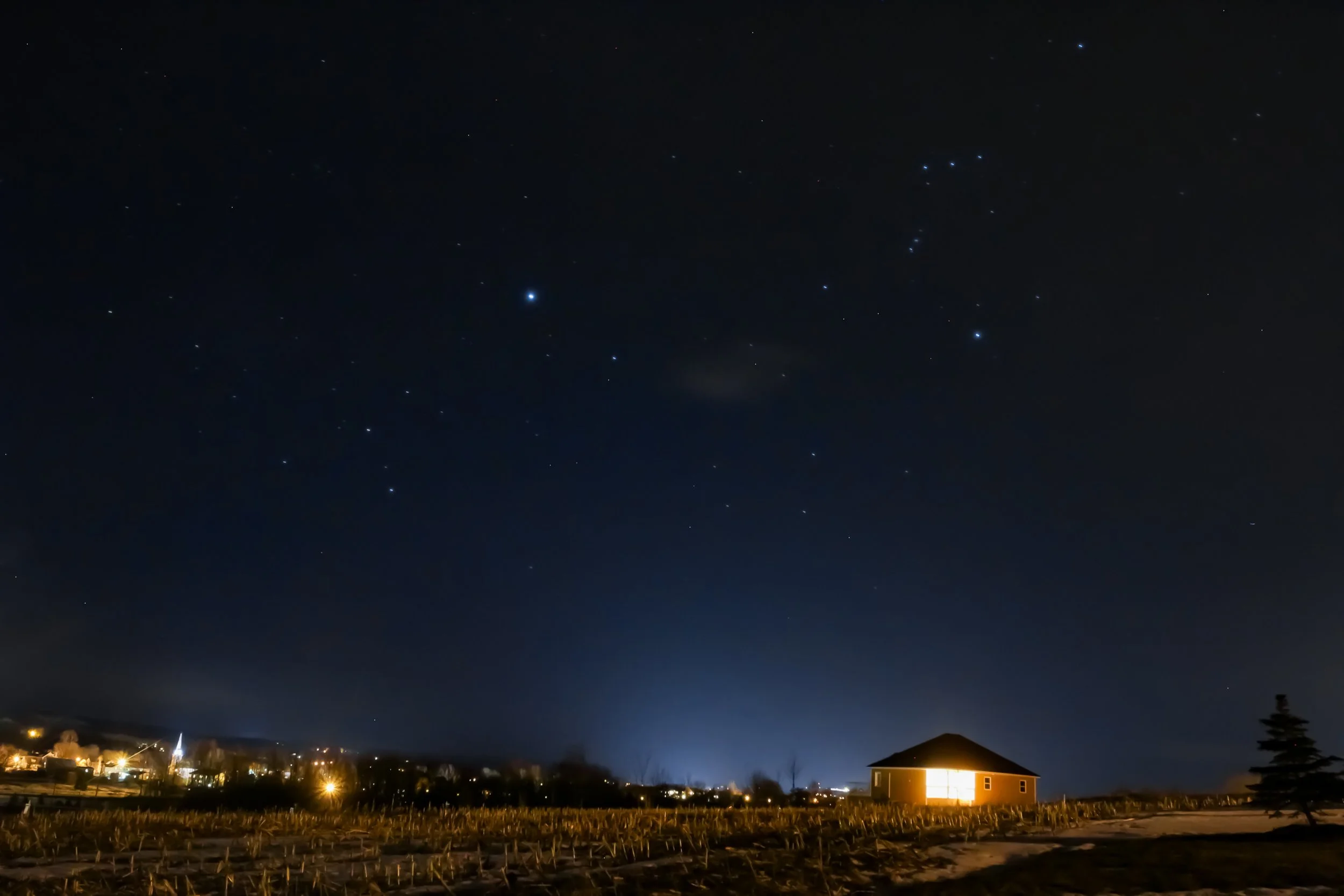
The brightest star in the sky, Sirius, blazes low in the west in march 2015 in the annapolis valley of nova scotia. sirius is the alpha star of the constellation canis major, the great dog. part of the constellation orion can be seen to the right. - John mcphee
The brightest star in the sky, Sirius, can be seen blazing very low in the early evening in May. It is found in the constellation Canis Major, the Big Dog. Above this constellation, you can test your constellation-location skills by finding the tiny constellation Canis Minor - you guessed it, the Little Dog.
Then there's the lesser known celestial yappers. I came upon one of them by chance one evening a few years ago in the constellation Virgo. I noticed a star just to the west of Saturn (which had moved into Virgo at the time), bright enough to stand out but not one I recognized.
It turns out this star has a pretty cool name, Zavijava (zah-vee-JAH-va). That’s Arabic for "the angle," according to astronomer Jim Kaler's website.
The name refers to Zavijava's position in a string of stars known to the ancient Arabs as "awwa," which some translate as the kennel or the barking dog.
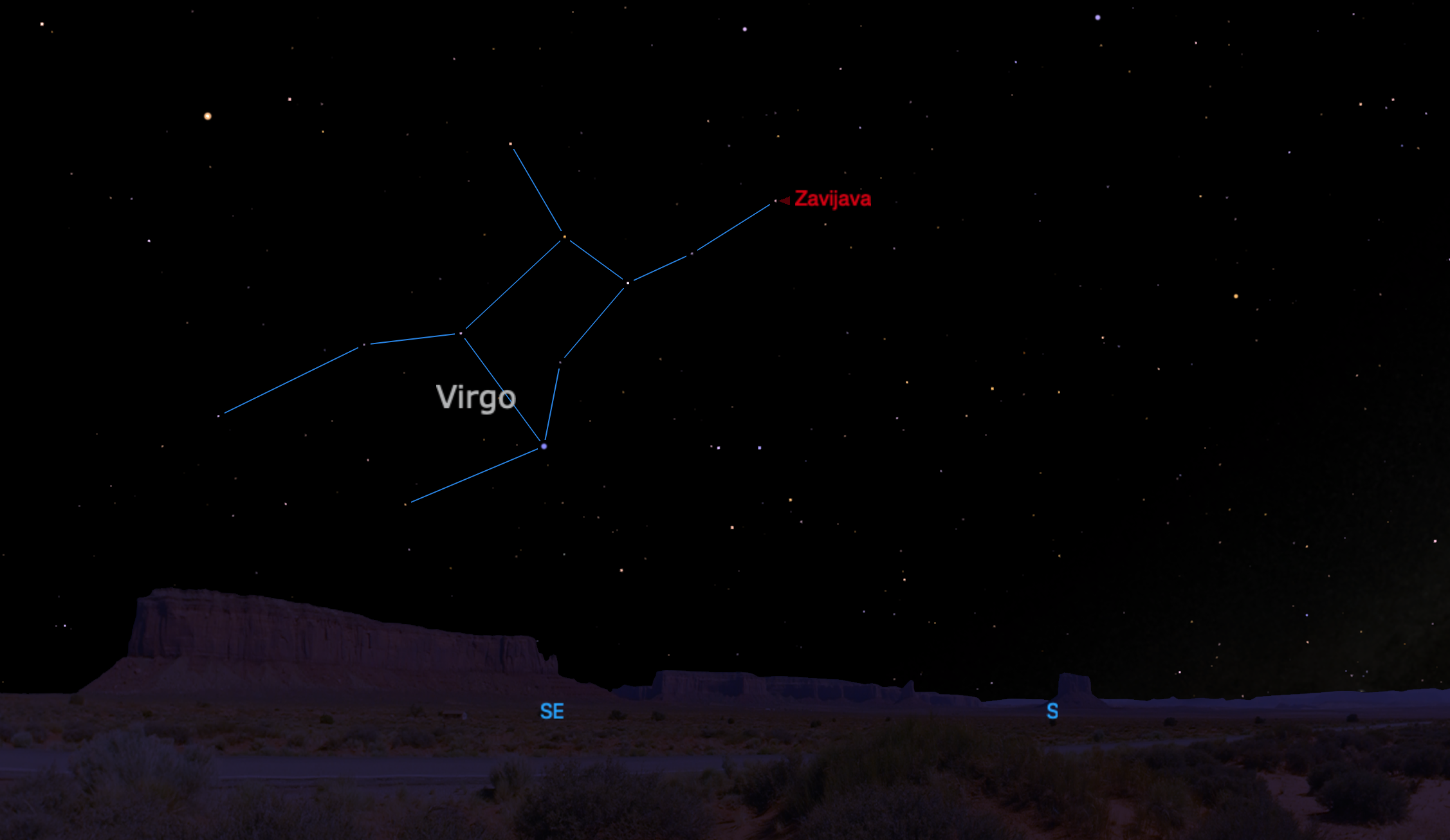
Zavijava's position in a string of stars in virgo was known to the ancient Arabs as "awwa," which some translate as the kennel or the barking dog. the graphic above shows its position in nova scotia after sunset in may.- starry night / curriculum
Einstein's star
Zavijava lies about 36 light years away - fairly close for a star but we’re still talking the equivalent of nearly 2.2 million round trips to our Sun.
On the other hand, Saturn, the sixth planet from the Sun, is a mere billion or so kilometres away.
In some ways, Zavijava is a typical breed of star - it's not that much larger or intrinsically brighter than our Sun. But it has an interesting history. Einstein used it during the solar eclipse of Sept. 21, 1922, to determine the speed of light in space. The scientist was able to use Zavijava as a celestial measuring stick because its path takes it close to the ecliptic, the path followed by the Sun and planets in the sky.
For the same reason, it often appears near planets and is even occulted, or covered, by them. Mark down Nov. 9, 2210, on your calendar when Venus will occult Zavijava, according to Wikipedia. There’ll be a similar occultation a little sooner (2069) but you’ll have to go to the South Pole to see it.
Wiki also tells us it's believed this star is orbited by at least one Jupiter-sized planet. Even the regular mutts of the cosmos can have an interesting tale to tell.